
There's a fundamental tension in SaaS content strategy. The broad category terms—“CRM software,” “email marketing tools,” “project management platforms”—have the highest search volumes. We're talking 50,000 to 200,000 monthly searches for competitive categories. But they're also the hardest to rank for, dominated by giants like G2, Capterra, and the software vendors with decades of domain authority.
So most SaaS companies skip these terms entirely. They focus on long-tail queries like “best CRM for real estate agents” or “project management for remote teams.” That's smart—you should absolutely go after those. But here's what I've learned watching companies execute content strategy over the years: the ones that eventually win category terms don't start by targeting them directly.
They build category hub pages that serve as the foundation for a content ecosystem. These hubs might not rank immediately, but they create the topical authority that eventually makes ranking possible. And in 2026, with AI Overviews and LLM-powered search increasingly shaping visibility, these hub pages have become even more critical for getting cited as a category authority.
This guide walks you through building category pages that work—both for traditional SEO and the emerging AI search landscape. For the broader context on SaaS comparison strategy, see our SaaS Comparison Page Playbook.
Understanding the Category Page's Role
Before diving into tactics, let's clarify what a category page actually is and how it differs from other content types in your SaaS content strategy.
What Makes a Category Page Different
A category page is a hub-level piece of content that covers an entire software category comprehensively. It's not a listicle of “10 Best CRM Tools”—though it might contain a listicle component. It's a resource that answers the fundamental questions someone has when entering a software category:
- What is this type of software and what problems does it solve?
- What are the key features and capabilities to look for?
- Who are the major players and how do they differ?
- How do I evaluate and select the right solution?
- What should I expect to pay?
Think of it as the page you'd want to read if you knew nothing about a category and needed to get smart quickly. It serves users at the very top of the funnel—people who might not even know your product exists yet.
The Hub-Spoke Architecture
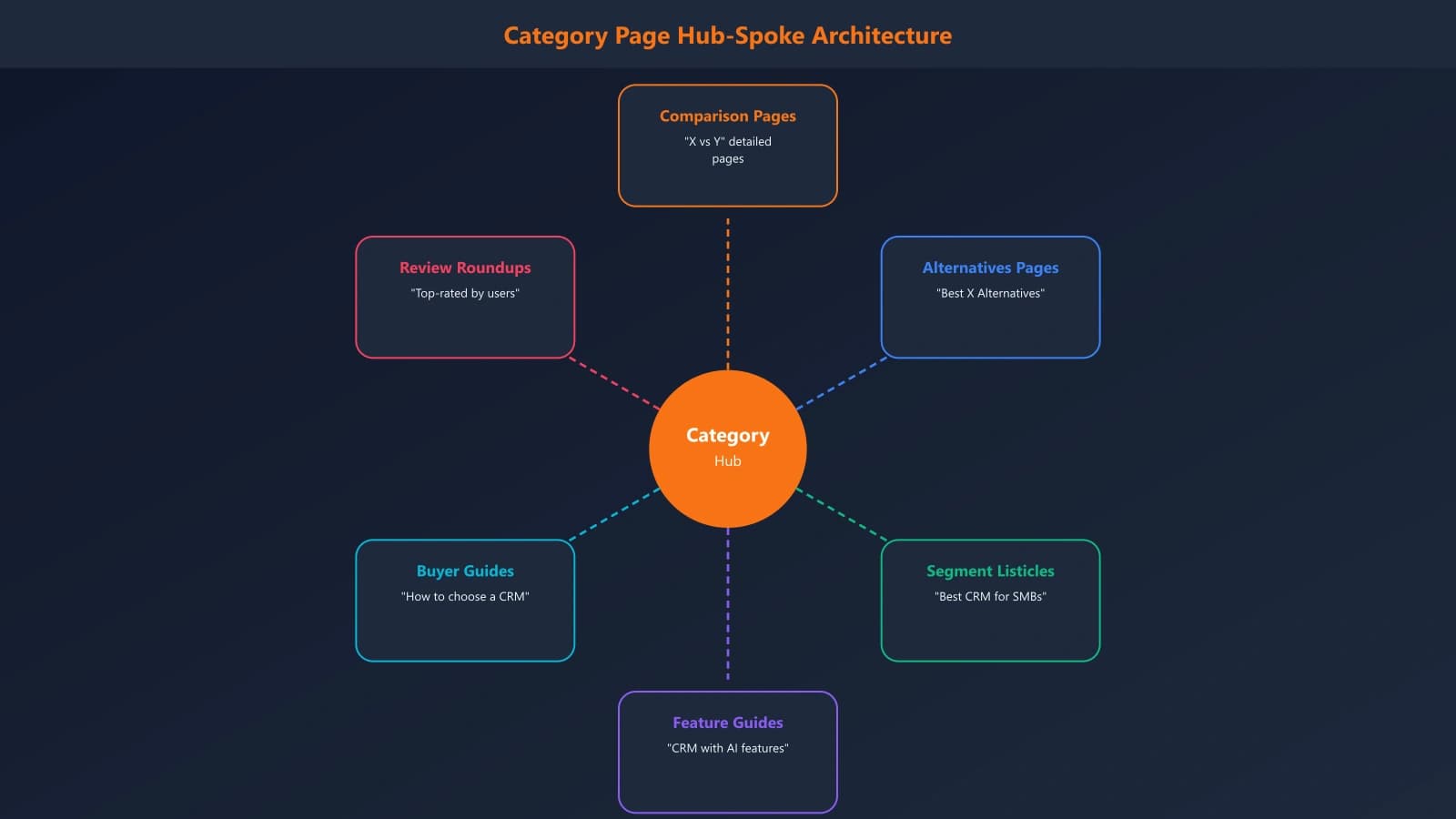
Category pages work best as the center of a hub-spoke content model. The category page is the hub, linking out to:
- Comparison pages: Specific product vs product comparisons
- Alternatives pages: “X alternatives” content for major competitors
- Segment-specific listicles: “Best for [industry/use case]” content
- Feature deep-dives: Content exploring specific capabilities
- Buyer guides: How-to content for evaluation and selection
The hub accumulates authority from all these spokes linking back to it. Over time, this creates the topical depth that search engines associate with genuine category expertise.
Structuring Category Page Content
The structure of your category page determines whether it serves users well and earns the signals search engines and AI systems look for. Here's the template that works.
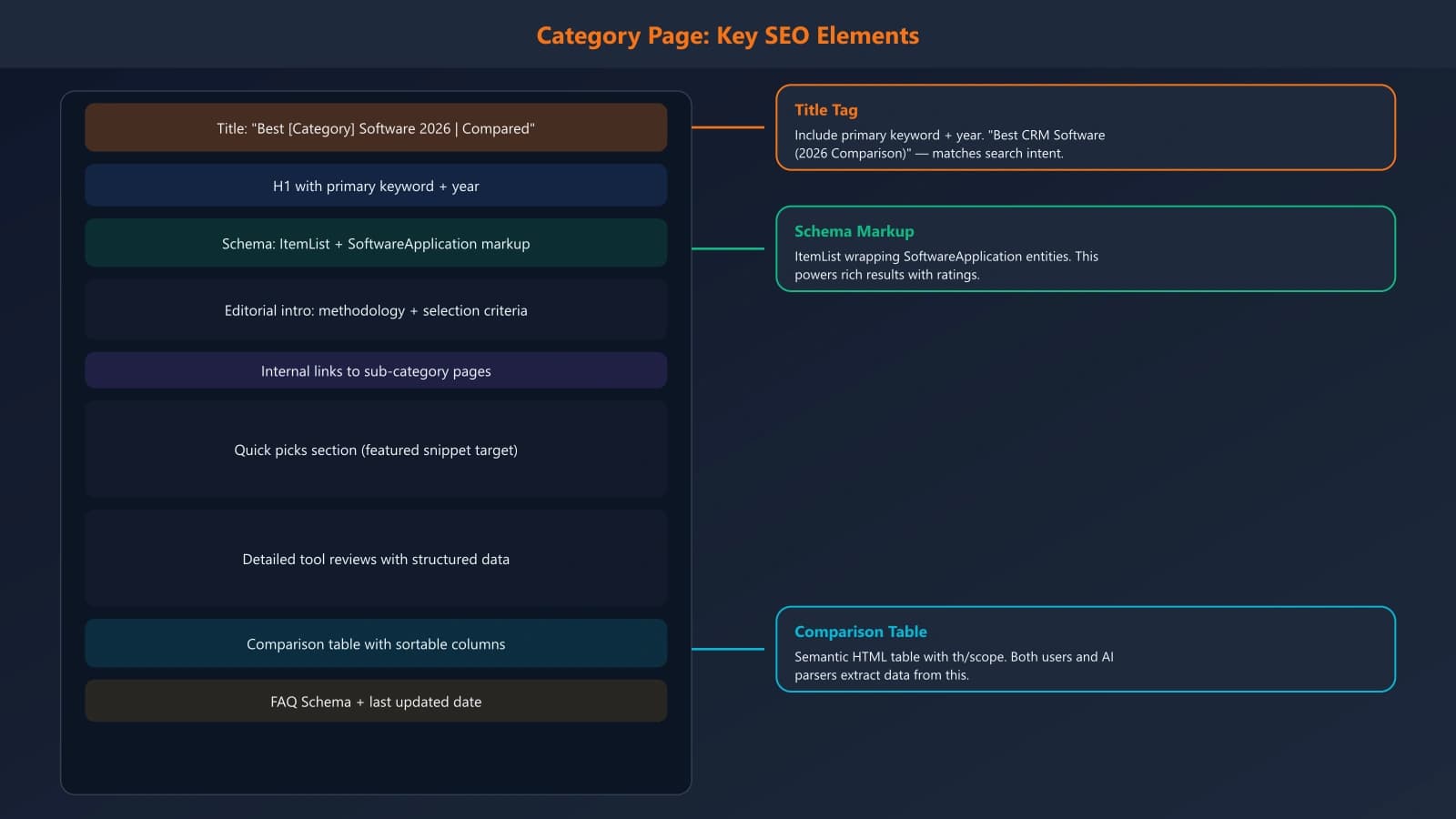
Essential Sections (In Order)
Based on analysis of top-performing category pages, structure yours with these sections:
- Definition and overview (200-300 words) — What this software category is, the core problem it solves
- Key features and capabilities (400-600 words) — The must-have and nice-to-have features, organized by importance
- Quick picks / featured solutions (300-400 words) — Top 3-5 options for different needs (link to individual pages)
- Full category breakdown (800-1200 words) — Comprehensive coverage of major players with brief descriptions
- How to evaluate and choose (400-600 words) — Selection criteria, red flags, evaluation process
- Pricing landscape (300-400 words) — Typical pricing models, ranges, what affects cost
- Implementation considerations (200-300 words) — What buyers should know about deployment
- FAQ section (400-600 words) — Common questions, structured for featured snippets
Word Count and Depth Guidance
Category pages need substantial depth—typically 3,000 to 5,000 words for competitive categories. But depth without structure creates walls of text that users abandon. Balance is key:
- Use clear headers: Every 200-300 words should have a new H2 or H3
- Include visual breaks: Tables, comparison charts, callout boxes
- Front-load value: The most actionable content comes first
- Create scannable paths: Users should be able to jump to what they need
SEO Optimization for Broad Category Terms
Ranking for broad category terms requires a different optimization approach than long-tail content. Here's what matters.
Title and Meta Strategy
For category pages, your title tag pattern should establish authority:
- Primary pattern: “[Category] Software: Complete Guide & Top Solutions (2026)”
- Alternative: “What is [Category] Software? Features, Examples & How to Choose”
- Meta description: Focus on comprehensiveness and specific value propositions
The year inclusion signals freshness. Update it annually along with a genuine content refresh.
Internal Linking That Transfers Authority
Your internal linking strategy makes or breaks category page performance:
- From spokes to hub: Every comparison, alternatives, and segment page links back to the category hub
- From hub to spokes: Category page links to specific pages for deeper exploration
- Cross-spoke links: Related content links to each other, all under the hub umbrella
- Navigation inclusion: Category pages should be accessible from main navigation
Schema Markup for Categories
Implement structured data that helps search engines understand your category coverage:
- FAQPage schema for the FAQ section
- ItemList schema for product listings
- Article schema for the page itself
- BreadcrumbList for navigation context
Build Category Authority at Scale
Generate comprehensive category pages with built-in hub-spoke architecture and SEO optimization.
Try for Free
Optimizing for AI Search and Citations
In 2026, category pages serve a dual purpose: ranking in traditional search and getting cited in AI-generated responses. The requirements overlap but aren't identical.
What AI Systems Look for in Category Content
AI systems like Google's AI Overviews and ChatGPT favor category content with specific structural patterns:
- Clear definitions: “[Category] software is...” statements early in content
- Structured comparisons: Tables and lists that are easy to extract
- Authoritative source signals: Citations to industry reports, official documentation
- Comprehensive coverage: Content that addresses the full scope of the category
- Updated information: Recent dates and current pricing/feature data
For a deeper dive on AI citation patterns, see our guide on how listicles get cited by AI Overviews—many of the same principles apply to category pages.
Entity Optimization for Categories
AI systems need to understand what entities your content covers. Strengthen entity signals by:
- Using canonical product names consistently (Salesforce, not “the CRM from Salesforce.com”)
- Including company information alongside product names
- Linking to official product pages when mentioning solutions
- Providing context that establishes category relationships
Freshness Signals That Matter
Both traditional and AI search heavily weight content freshness for category pages:
- Visible update dates: Show when content was last reviewed
- Current pricing: Update pricing data quarterly
- Recent developments: Note new entrants, acquisitions, major feature launches
- Year references: Use current year in titles and throughout content
Competitive Positioning on Category Pages
If you're a SaaS vendor creating a category page, you face a unique challenge: how do you cover your own category objectively while still positioning your product favorably?
The Neutrality Balance
The most effective approach isn't pretending to be neutral—readers know you have a stake. Instead, demonstrate expertise through genuinely helpful content while being transparent about your position:
- Disclose your role: “We build [product], so we know this category well...”
- Cover competitors fairly: Include major players with accurate descriptions
- Don't manipulate rankings: If you include a listicle component, rank based on genuine fit
- Add unique value: Include insights only an industry insider would have
Strategic Placement of Your Product
When including your own product:
- Don't automatically rank yourself #1—it damages credibility
- Position for specific use cases where you genuinely excel
- Acknowledge competitor strengths in areas you don't compete
- Link to your comparison pages for deeper competitive context
Maintaining Category Pages Over Time
Category pages aren't set-and-forget content. The SaaS landscape changes constantly, and stale category content loses both rankings and trust.
Recommended Update Schedule
| Element | Update Frequency | Trigger Events |
|---|---|---|
| Pricing information | Quarterly | Vendor pricing changes |
| Product listings | Quarterly | New entrants, acquisitions, shutdowns |
| Feature comparisons | Semi-annually | Major product launches |
| Full content refresh | Annually | Year change, significant industry shifts |
| FAQ section | Quarterly | New common questions emerging |
Tracking Changes and Updates
Build a simple tracking system:
- Maintain a changelog document for each category page
- Set calendar reminders for scheduled reviews
- Monitor SERP changes to catch when competitors update their content
- Track AI citation frequency to catch drops that might indicate staleness
Measuring Category Page Success
Category pages have different success metrics than bottom-funnel content. Here's what to track.
Key Performance Indicators
- Organic traffic: Obviously, but track trend over time rather than absolute numbers
- Ranking position: For the primary category term and related long-tail variations
- Time on page: High engagement suggests the content is serving users well
- Scroll depth: Are users consuming the full content?
- Hub-to-spoke clicks: Are users navigating to your comparison and alternatives content?
- Branded search lift: Does category page traffic correlate with increased branded searches?
AI Visibility Tracking
As AI search grows, add these metrics:
- Frequency of AI Overview citations for category queries
- Mentions in ChatGPT/Claude responses when asked about the category
- Perplexity citation frequency
For methodology on tracking AI visibility, see our guide on measuring AI visibility for listicles.
Building Long-Term Category Authority
Category pages are a long game. You probably won't rank for “CRM software” in year one. But the companies that do own those terms didn't get there by ignoring them—they built comprehensive content ecosystems with category hubs at the center.
The key insights:
- Think hub-spoke: Category pages anchor a content architecture, not stand alone
- Structure for scanners and AI: Clear sections, tables, and definitions
- Maintain relentlessly: Stale category content loses trust and rankings
- Be honest about your position: Credibility beats aggressive self-promotion
- Measure what matters: Traffic is one metric, but authority signals matter more long-term
Start with the category most central to your product. Build the hub, then systematically add spokes—comparison pages, alternatives content, segment-specific listicles. Within 12-18 months, you'll have the topical depth that makes ranking for broad terms achievable.
For the complete context on SaaS content strategy, see our SaaS Comparison Page Playbook. And for execution on individual content types, explore our guides on trust signals for B2B comparisons and enterprise software listicles.

Product Manager at BestPage. Pioneer in AEO research since 2024, exploring the convergence of SEO and GEO (Generative Engine Optimization). Led multiple AI-powered content optimization projects that achieved 300%+ citation increases in ChatGPT and Perplexity.