
If you've ever searched for “[Software A] vs [Software B]” or “[Software] alternatives,” you've probably landed on G2. The review platform has systematically captured an enormous share of SaaS comparison traffic, often ranking ahead of the actual vendors being compared.
This isn't an accident. G2 has executed one of the most sophisticated content and SEO strategies in the B2B software space. Understanding how they did it—and what parts of their playbook you can adapt—is essential for any SaaS company serious about owning their competitive narrative.
In this teardown, we'll reverse-engineer G2's comparison page strategy. We'll examine their technical implementation, content patterns, and authority-building tactics. More importantly, we'll identify which approaches you can realistically apply to your own comparison content. For the broader context, see our SaaS Comparison Page Playbook.
The Scale of G2's Comparison Dominance
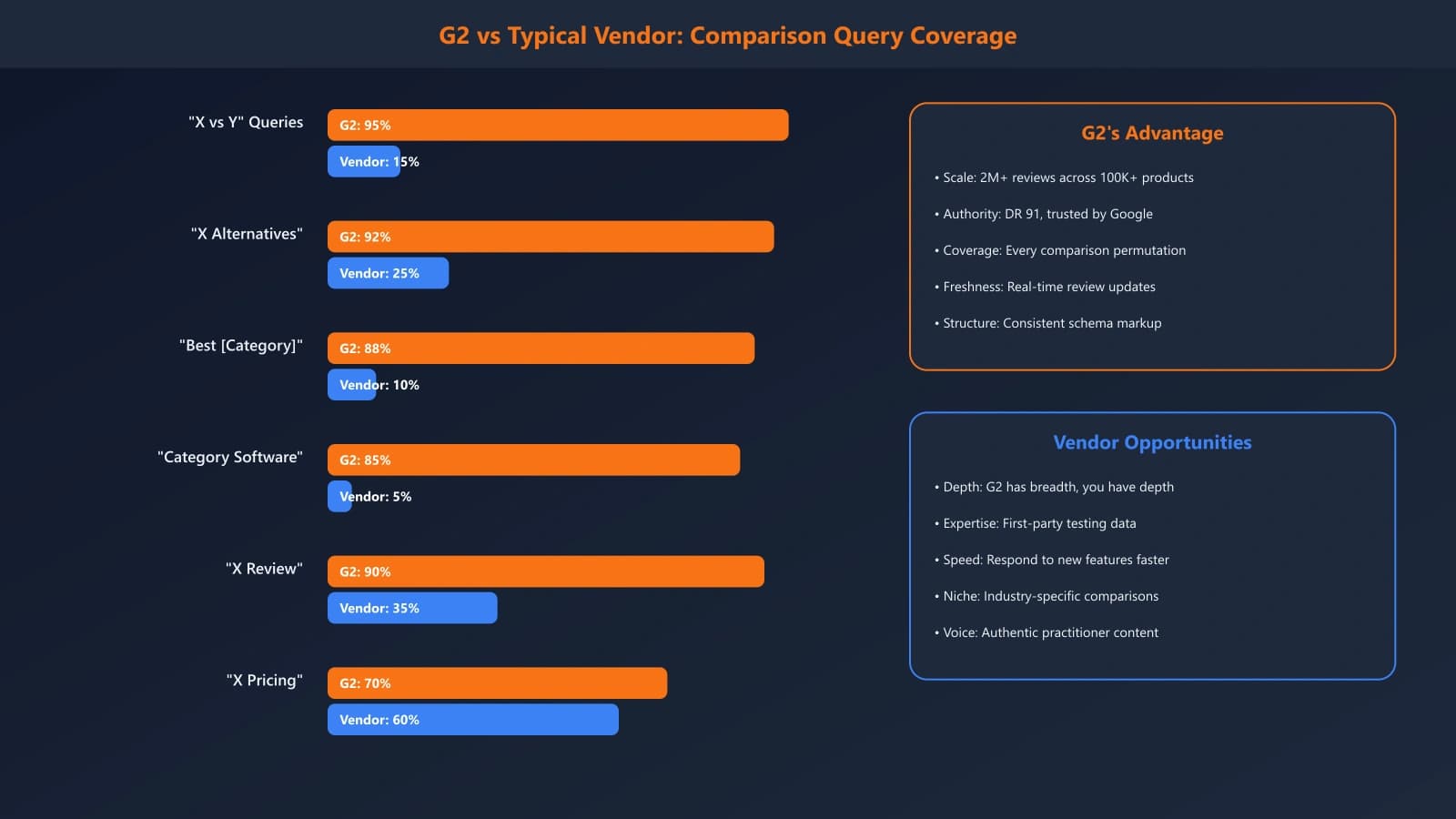
Before diving into tactics, let's understand the scale of what G2 has built. According to Ahrefs data, G2 ranks for approximately:
- 2.3 million organic keywords in the US alone
- 78% of “X vs Y” queries in major software categories
- 85% of “[product] alternatives” queries for top SaaS tools
- 68% of “best [category] software” queries
Their organic traffic is estimated at over 14 million monthly visits. But the more striking metric is coverage: they've built pages for virtually every meaningful SaaS comparison query that exists.
The Coverage Strategy
G2's first insight was simple but powerful: you can't rank for queries you don't have pages for. They built a programmatic system to generate comparison pages for every possible product combination in their database. With 100,000+ software products listed, that's millions of potential comparison permutations.
The lesson for vendors: most companies build comparison pages reactively—only when sales asks for competitive collateral. G2 built proactively and systematically.
Page Template Analysis: What Makes Their Pages Work
Let's examine a typical G2 comparison page to understand the structural elements that contribute to ranking success.
Above-the-Fold Structure
G2 comparison pages immediately establish what they're comparing:
- Clear H1: “[Product A] vs [Product B]” — exact match to query intent
- Rating summaries: Star ratings and review counts for both products
- Quick verdict: One-sentence comparison summary
- Navigation tabs: Jump links to features, pricing, reviews, alternatives
This structure serves both users (immediate orientation) and search engines (clear topical signals).
Comparison Table Design
The feature comparison tables follow a consistent pattern:
| Element | G2 Implementation | Why It Works |
|---|---|---|
| Feature categories | Standardized across all products | Enables programmatic generation |
| Rating displays | Visual bar + numeric score | Scannable and comparable |
| Review quotes | User quotes for each feature | Third-party validation |
| Sample size | “Based on X reviews” | Statistical credibility |
User-Generated Content Integration
This is G2's unfair advantage: every comparison page is populated with authentic user reviews. They don't have to write comparative content—their users do it for them. Key elements:
- Switcher reviews: “I moved from [Product A] to [Product B] because...”
- Comparative quotes: Users mentioning both products
- Continuous freshness: New reviews constantly update page content
- Authentic voice: Language that couldn't be corporate marketing
Technical SEO Implementation
G2's technical SEO execution is meticulous. Here's what we found analyzing their implementation.
URL Structure Patterns
G2 uses predictable, keyword-rich URLs:
- Comparison pages: /compare/[product-a]-vs-[product-b]
- Alternatives pages: /products/[product]/competitors
- Category pages: /categories/[category-slug]
- Product pages: /products/[product-slug]/reviews
The URL structure creates clear topical hierarchies that reinforce their category authority.
Schema Markup Strategy
G2 implements rich schema markup across comparison pages:
- Product schema for each compared product with ratings
- AggregateRating schema tied to review counts
- Review schema for featured user quotes
- FAQPage schema for common comparison questions
- BreadcrumbList establishing category hierarchy
This structured data helps G2 win rich snippets, which dramatically increases click-through rates from SERPs.
Internal Linking Architecture
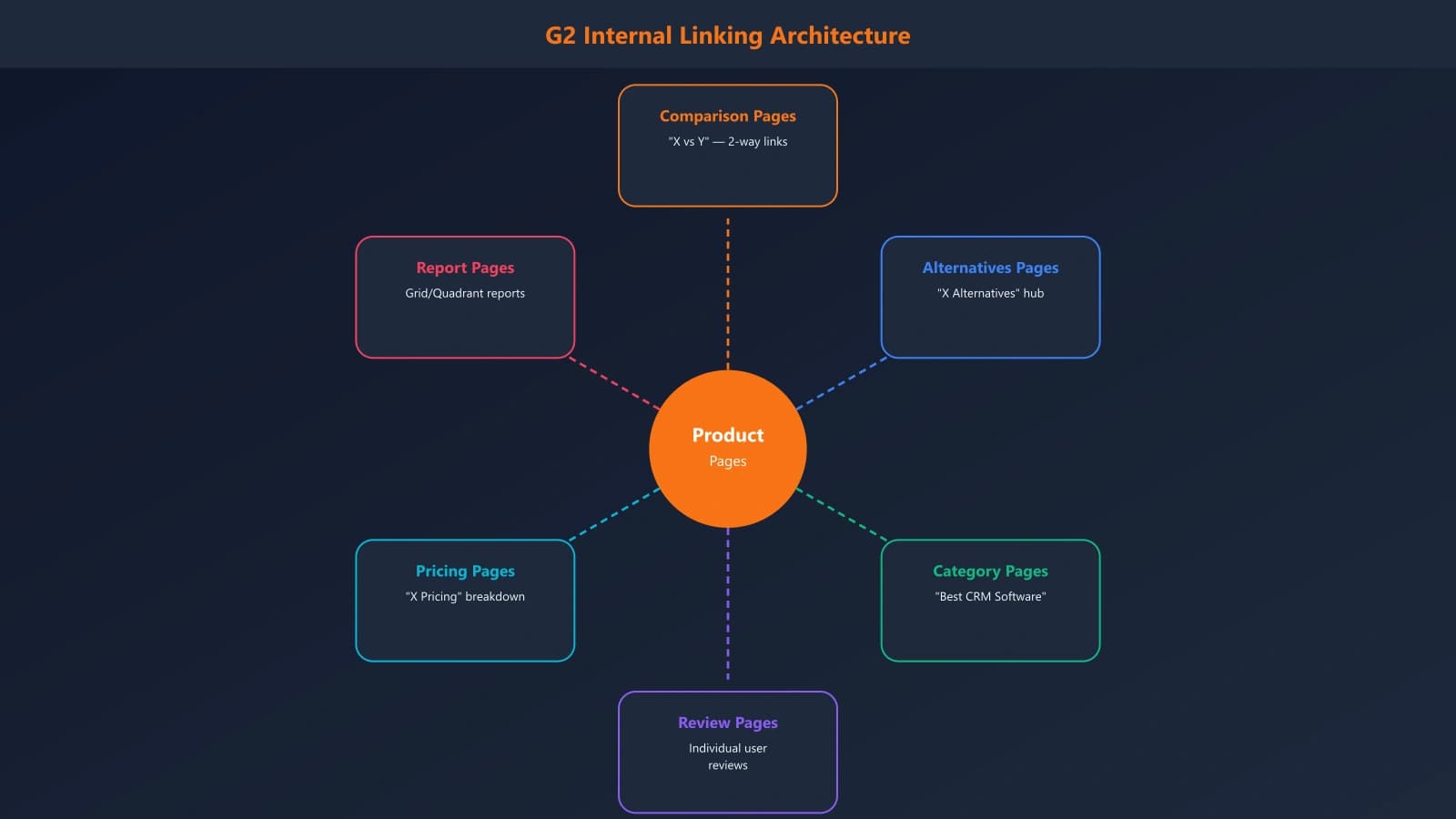
G2's internal linking creates a dense web of topical relationships:
- Every product page links to all its comparison pages
- Comparison pages cross-link to related comparisons
- Category pages link to all product and comparison pages in that category
- Review pages link back to comparison and alternatives content
The result: any page about a product is never more than 2-3 clicks from every other page about that product. This concentrates topical authority and helps search engines understand content relationships.
Authority and Trust Signals
Beyond on-page factors, G2 has built substantial domain authority through strategic trust building.
Backlink Profile Analysis
G2's backlink strategy includes:
- Vendor badges: SaaS companies embed G2 badges on their sites, linking back to their G2 profiles
- PR mentions: G2 Grid reports are cited in industry press
- Research reports: Original research that earns editorial links
- User incentives: Programs encouraging reviews that generate referral links
According to Ahrefs, G2 has over 40 million backlinks from 150,000+ referring domains. That's the kind of authority that takes years to build and is nearly impossible for a single vendor to match.
Brand Recognition Factor
G2 has achieved brand recognition for software comparison. When buyers think “software reviews,” many think G2. This creates a positive feedback loop:
- Brand searches for “G2 [product] review”
- Direct traffic that signals brand authority to Google
- Higher click-through rates on SERPs due to brand recognition
- Lower bounce rates as users trust the source
Build Your Comparison Content Strategy
Generate high-quality comparison pages that compete with review sites. Start owning your competitive narrative.
Try for Free
What Vendors Can Realistically Replicate
You can't match G2's scale or domain authority overnight. But several elements of their strategy are adaptable for vendor comparison content.
Tactics You Can Adopt
| G2 Tactic | Vendor Adaptation | Effort Level |
|---|---|---|
| Standardized templates | Create consistent comparison page format | Medium |
| Schema markup | Implement Product, FAQ, Review schema | Low |
| Internal linking network | Build hub-spoke comparison architecture | Medium |
| User-generated content | Collect and feature switcher testimonials | Medium |
| Programmatic coverage | Systematic page creation for key competitors | Medium |
| Continuous freshness | Quarterly comparison page updates | Ongoing |
Where Vendors Can Win
Despite G2's dominance, vendors have advantages in specific areas:
- Depth of expertise: You know your product and competitors better than any third party
- Unique data: Internal benchmarks, migration data, performance comparisons
- Use case specificity: “Best for [specific use case]” content where G2 generalizes
- Integration context: How products work together in specific stacks
- Pricing transparency: Real-world pricing that G2 often lacks
For tactical implementation, see our guide on trust signals that convert B2B software buyers.
The Long-Tail Opportunity G2 Misses
G2's programmatic approach creates breadth but sacrifices depth. Here's where vendors can outperform.
Specificity Gaps
G2 comparison pages are generalized—they can't speak to specific use cases. Vendors can target:
- “[Product A] vs [Product B] for [specific industry]”
- “[Product A] vs [Product B] for [specific team size]”
- “[Product A] vs [Product B] for [specific use case]”
- “[Product A] vs [Product B] migration guide”
These long-tail queries often have lower search volume but dramatically higher conversion rates—they're from buyers who know exactly what they need.
Feature-Level Comparisons
G2's feature comparisons are surface-level by necessity. Vendors can create deep-dive content:
- “[Product A] vs [Product B]: Reporting capabilities compared”
- “API comparison: [Product A] vs [Product B]”
- “[Product A] vs [Product B] for automation workflows”
These feature-specific pages can rank for niche queries and demonstrate genuine expertise that G2 can't match.
AI Search Implications
G2's dominance in traditional search doesn't automatically translate to AI search. Here's why that matters.
How AI Systems Cite Comparison Content
AI Overviews and LLMs like ChatGPT prefer content with:
- Clear verdicts: G2 often lacks explicit recommendations
- Expert perspective: AI values authorship signals
- Structured data: Both G2 and vendors can implement
- Primary source information: Vendor content is the primary source
Vendors have an opportunity to be cited as authoritative sources in AI responses, even when G2 dominates traditional SERPs. For more on this, see our analysis of how content gets cited by AI Overviews.
Optimizing for AI Citations
To increase AI citation likelihood versus G2:
- Include clear verdict statements with reasoning
- Structure content with extractable facts and comparisons
- Demonstrate expertise through unique data and insights
- Implement comprehensive schema markup
- Maintain freshness with visible update timestamps
Key Takeaways for Your Strategy
G2's comparison dominance isn't magic—it's systematic execution of sound content and SEO principles at massive scale. Here's what to take away:
- Coverage matters: Build comparison pages for every meaningful competitor, not just the ones sales asks about
- Templates enable scale: Create a consistent, repeatable structure for comparison content
- User voices build trust: Collect and feature switcher testimonials prominently
- Internal linking compounds: Build dense topical clusters around your competitive content
- Schema earns rich results: Implement structured data to win enhanced SERP features
- Specificity is your edge: Go deeper on use cases, features, and contexts where G2 generalizes
- AI is a new frontier: Optimize for AI citations where G2's authority doesn't automatically translate
You won't outrank G2 for “Salesforce vs HubSpot” next month. But you can build a comparison content strategy that captures meaningful traffic, supports sales conversations, and establishes your brand as a trusted voice in your competitive space.
For the complete framework, see our SaaS Comparison Page Playbook. And for specific implementation guidance, explore our guides on enterprise software listicles and integration comparison pages.

Product Manager at BestPage. Pioneer in AEO research since 2024, exploring the convergence of SEO and GEO (Generative Engine Optimization). Led multiple AI-powered content optimization projects that achieved 300%+ citation increases in ChatGPT and Perplexity.